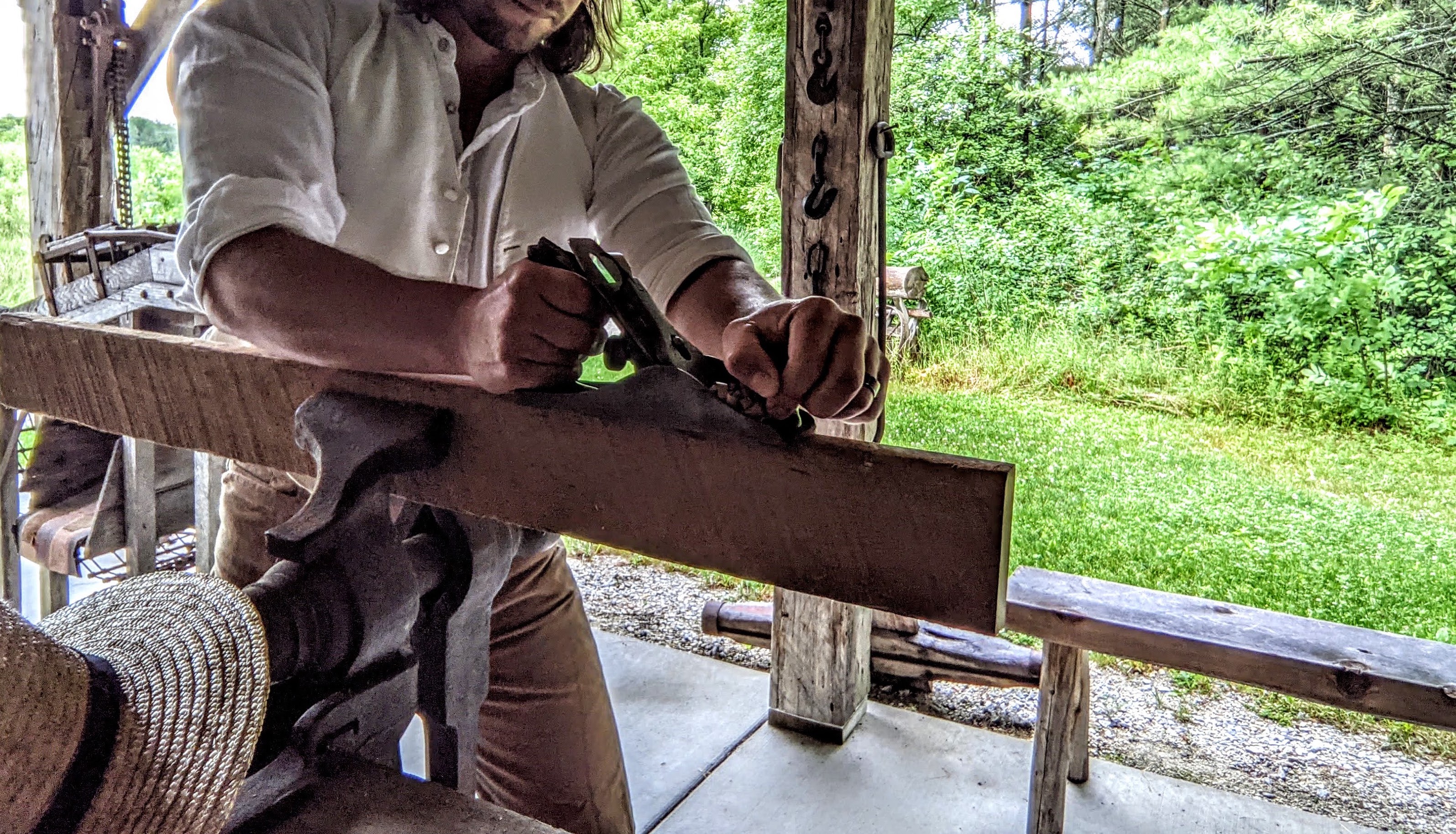
Hand-tool woodworking in Canada is shaped partly by the climate. Shops in Alberta and Manitoba experience dramatic humidity swings between dry winters and humid summers, which means wood moves — and tool setups that were dialled in October may need adjusting come March. The tools described here are selected for their reliability, repairability, and usefulness across a wide range of projects from small boxes to full furniture.
This is not an exhaustive list. It covers the tools that experienced hand-tool woodworkers in Canada consistently reach for first, based on the nature of projects — benches, cabinets, chairs, small boxes — that suit a garage or basement shop.
Saws
Panel saw (cross-cut, 8 or 9 points per inch)
A good cross-cut panel saw handles the bulk of dimensioning work — cutting boards to rough length and width before the hand plane takes over. An 8-point saw cuts faster; a 9-point leaves a cleaner kerf. The classic choice is a Disston No. 12 from the 1920s–1960s, available used at Canadian antique markets and estate sales for $20–$50. New options include the Veritas cross-cut saw (Lee Valley) or a Japanese ryoba, which cuts on both pull and push strokes.
Tenon saw (13–16 points per inch)
The tenon saw — also called a backsaw — is for precise joinery cuts: tenon cheeks, dovetail sides, and housing dados. The stiffened back keeps the blade tracking straight. A 14-inch, 13-point tenon saw is a versatile choice. Lie-Nielsen and Veritas both produce Canadian-friendly options (Lee Valley ships from Ottawa). Used Disston tenon saws are another strong choice at similar prices.
Coping saw
Used for removing the waste between dovetails and for cutting curved profiles. A 16-tooth-per-inch blade cuts cleanly without splintering. Replace blades regularly — a dull coping saw blade wanders and splits the wood.
Planes

No. 5 jack plane
The jack plane is the workhorse — it does rough dimensioning, face flattening, and edge jointing when set with a cambered iron. A No. 5 in a Canadian shop handles 80% of planing tasks. Stanley Baileys from the 1950s–1970s are widely available at flea markets across Ontario and Quebec for $25–$60 after cleanup. The Lie-Nielsen No. 5 and the Veritas bevel-up jack are the new-tool options at $150–$280 CAD.
No. 4 smoothing plane
Used for final surface preparation before finishing. The No. 4 is set with a very fine cut and a razor-sharp iron. A properly tuned No. 4 on maple or cherry produces a surface that needs no sandpaper — the fibres are cut cleanly rather than abraded. For Canadian hardwoods like hard maple and black walnut, a thick A2 or PMV-11 iron (both made in Canada by Veritas) holds an edge significantly longer than the O1 irons in vintage planes.
No. 7 jointer plane
At 22 inches long, the No. 7 rides over hollows and flattens high spots, making it essential for truing up the long edges of boards before glue-up and for flattening a glued-up benchtop. Not the first plane to buy, but indispensable once you start gluing up panels.
Block plane (low-angle)
A low-angle block plane with a 12–13 degree bed angle cuts end grain cleanly — useful for trimming tenon end grain flush, shooting mitre joints, and cleaning up small surfaces. The Veritas low-angle block plane (Lee Valley, made in Ottawa) is a highly regarded Canadian option that holds its adjustment under use.
Chisels

Bench chisels (set of 4: 1/4", 1/2", 3/4", 1")
Four bevelled-edge bench chisels cover the vast majority of joinery work. The 1/4-inch is for small mortises and detail work; the 1-inch is for paring wide surfaces and cleaning up housing dadoes. A Canadian shop that does a lot of mortise-and-tenon joinery will wear out the 1/2-inch chisel first.
The Veritas PM-V11 bench chisels are a Canadian-made option at around $30–$40 CAD each. Narex chisels from Czechoslovakia offer similar performance for less, and are sold through most Canadian woodworking retailers. Vintage Buck Bros. and Stanley chisels, found at antique markets across Canada, are serviceable after sharpening.
Mortise chisel (3/8" or 1/2")
A mortise chisel is heavier than a bench chisel, with a thick blade designed to be driven with a mallet and levered to break chips out of a deep mortise. For a typical furniture mortise (3/8 inch wide, 1.5 inches deep), the chisel is struck 3–4 times across the grain, then the handle is levered back to snap the chip free. A used English socket mortise chisel in 3/8 inch from an estate sale is worth whatever it costs — they are nearly indestructible.
Layout and marking tools
Marking gauge
A wheel-style marking gauge (the Veritas wheel marking gauge is a Canadian benchmark product) scores a crisp, consistent line parallel to a face or edge. Used for laying out tenon shoulders, dovetail baseline depths, and mortise locations. The wheel cutter severs fibres cleanly; a pin-style gauge drags and can follow grain in the wrong direction on Canadian hardwoods like hard maple.
Marking knife
A marking knife registers against a square or straightedge and severs fibres at the baseline — creating a knife wall that a chisel can register in. Any single-bevel knife with a thin blade works. The Blue Spruce marking knife (American but widely sold in Canada) and the Veritas marking knife are common choices.
Combination square
A 12-inch combination square is used for checking 90-degree and 45-degree angles, setting gauges, and measuring depth. A quality square (Starrett or Mitutoyo) stays accurate under shop use. A cheap combination square can be off by a degree, which introduces compounding errors in joinery.
Sliding bevel
For transferring angles — particularly the dovetail angle (typically 1:8 for hardwoods, 1:6 for softwoods in Canadian practice) — a sliding bevel locks at any angle and transfers it to the wood. The Veritas sliding bevel uses a brass locking mechanism that doesn't creep under use.
Sharpening tools
Sharp tools are not a refinement — they are a prerequisite. A dull plane or chisel requires more force, chatters, and tears wood fibres rather than cutting them. In a Canadian shop, where humidity changes can cause plane soles to rust overnight if left unprotected, a consistent sharpening routine is essential.
The most reliable sharpening setup for a beginner: a coarse diamond plate (DMT 220-grit) for initial flattening of the back, a medium water stone (King 1000-grit), and a finishing stone (King 6000-grit or a Shapton 8000-grit). Follow with a leather strop loaded with green buffing compound. This progression takes a new Narex chisel from factory edge to shaving-sharp in under ten minutes.
Rust prevention in Canadian shops: Humidity swings between summer and winter cause condensation on unprotected metal. Wipe all plane soles and chisel blades with a light coat of paste wax (Johnson's or Renaissance wax) or camellia oil after each session. A dehumidifier running in summer significantly extends the life of tool edges in humid regions like coastal British Columbia.
Where to buy tools in Canada
Lee Valley Tools operates retail locations in eight Canadian cities (Vancouver, Calgary, Ottawa, Toronto, and others) and ships nationally. They manufacture the Veritas line in Ottawa and carry a curated selection of Japanese and European hand tools. For vintage tools, estate sales in Ontario and Quebec are the best sources — both regions have dense histories of furniture and cabinet manufacturing, and quality vintage tools surface regularly.
The Woodworking Network maintains a directory of Canadian retailers. The Canadian Wood Council provides species and grading references that help when selecting lumber at the yard.
For the project that put all these tools to work, see the workbench build guide. For the wood species that suit hand-tool work best in Canada, the wood species guide covers the relevant properties.

