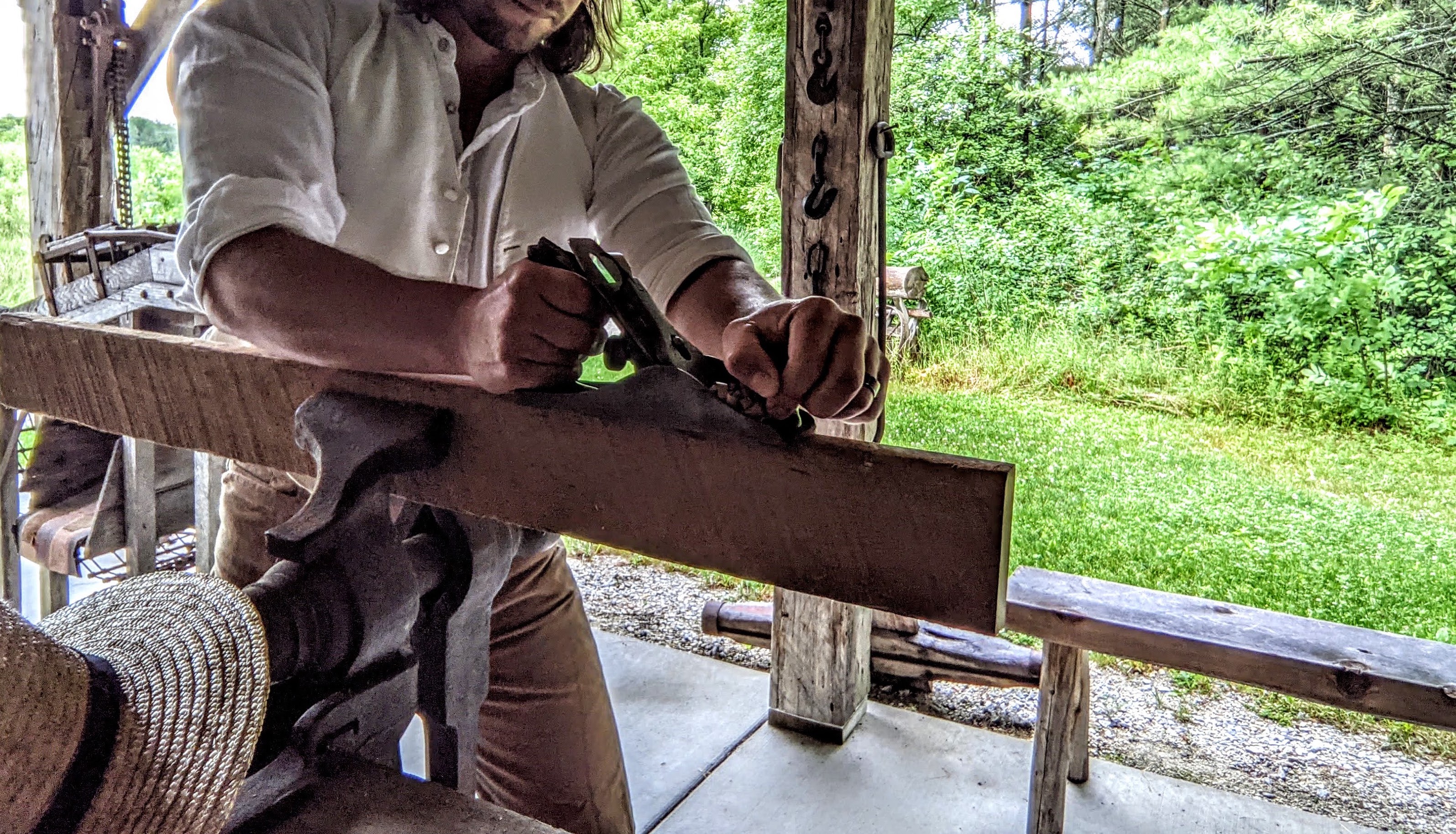
Three species stand out in Canadian hand-tool woodworking as widely available, well understood, and well suited to furniture-scale projects: hard maple (Acer saccharum), eastern white pine (Pinus strobus), and black walnut (Juglans nigra). Each has a distinct working character at the bench — knowing these properties before buying lumber saves both time and material.
Prices and availability vary by region. Maple dominates in Ontario and Quebec, where sugar maple forests are extensive. White pine is abundant across the Maritime provinces and Central Canada. Black walnut is less common in the wild north of the Great Lakes region but is commercially available from specialty lumber dealers across Canada.
Hard maple (Sugar maple) — Acer saccharum

Properties
Hard maple is one of the densest domestic hardwoods available in Canada, with a Janka hardness of approximately 1450 lbf. The grain is typically straight, fine-textured, and even — it mills to a glass-smooth surface with sharp tools. Colour ranges from nearly white to a light tan with occasional pink or grey tones. Quartersawn maple shows a distinctive ray figure (often called "bird's eye" when curly patterns develop).
- Janka hardness: ~1450 lbf
- Specific gravity (air-dried): 0.63
- Tangential shrinkage: 9.9%
- Radial shrinkage: 4.8%
- Common thickness at Canadian yards: 4/4, 5/4, 8/4
Working with hard maple
Hard maple is demanding on tools. Dull plane irons tear the grain rather than cutting it — the fibres are dense enough that even a marginally sharp iron chatters. A No. 4 smoothing plane on hard maple requires a freshly stropped iron, a tight mouth, and a cap iron set close to the cutting edge. Planing against the grain produces severe tearout; always read the grain direction from the long edge of the board before setting the plane's direction.
Chisels need to be sharpened to a finer angle on maple — 30 degrees rather than the 25 degrees used for softer species. The dense fibres also compress rather than split cleanly if the chisel is struck too hard during mortising. Work in smaller increments and clear chips frequently.
Finishing hard maple
Maple is notoriously difficult to stain evenly — the dense surface resists even penetration, leading to blotchy results with oil-based stains. The most reliable finishes for maple are:
- Shellac (dewaxed, 2-lb cut) applied in thin coats as a sealer, then overcoated with lacquer
- Waterlox (a penetrating tung oil varnish) applied in 3–4 coats, with light sanding between coats
- Danish oil thinned 1:1 with mineral spirits for the first coat, then full-strength for subsequent coats
A gel stain is the most reliable option if colour is needed — gel stains sit on the surface rather than penetrating unevenly. Pre-conditioners help but don't eliminate blotching completely on dense maple.
Best uses in Canadian shops
Workbench tops, kitchen cutting boards, cabinet carcasses, dining table tops, and tool handles. Maple's hardness makes it the natural choice where wear resistance matters. It is the standard material for bowling alley lanes and dance floors — an indication of its durability.
Eastern white pine — Pinus strobus
Properties
Eastern white pine is the softwood most associated with early Canadian furniture, particularly the painted pieces of Upper Canada and the Maritimes from the 18th and 19th centuries. It is soft, light, and easy to work by hand — a novice can flatten a 2×6 of white pine in 10 minutes with a jack plane. The grain is straight, the texture coarse, and the colour ranges from a cream-white in the sapwood to a warm honey-gold in the heartwood.
- Janka hardness: ~380 lbf
- Specific gravity (air-dried): 0.35
- Tangential shrinkage: 6.1%
- Radial shrinkage: 2.1%
- Common thickness at Canadian yards: 1×6, 1×8, 1×12 nominal; also 4/4 and 5/4 rough from specialty mills
Working with eastern white pine
Pine is forgiving at the bench. Hand planes work easily along the grain; even moderately sharp tools produce a usable surface. The main challenge is denting — pine dents from a thumbnail, so surfaces need protection during and after assembly. Knots are common in construction-grade pine and require either avoidance or careful planning: a knot intersecting a tenon shoulder creates a weak point that can break under stress.
Pine glues well with PVA glues (Titebond I or II) but the open time is short because pine absorbs the first coat quickly. Apply glue to both mating surfaces, allow 30–60 seconds for the first coat to absorb ("sizing"), then apply a second coat and assemble. This two-coat approach produces significantly stronger joints in softwoods.
Finishing eastern white pine
Pine finishes readily with oil, paint, or shellac. The traditional Canadian finish for pine furniture is milk paint (available from The Old Fashioned Milk Paint Company, which ships to Canada), followed by a coat of paste wax. This produces the low-sheen, aged appearance associated with early Upper Canadian pieces. For a natural look, boiled linseed oil (two coats, one week apart) amber the wood slightly and provide moderate protection.
Pine in dry Canadian winters: White pine has a low radial shrinkage of 2.1% but higher tangential movement. A wide pine panel in a Prairie home can move 3/8 inch across a 12-inch board over a full heating season. Design for movement — floating panels, elongated screw holes, and no gluing across the width of wide boards.
Black walnut — Juglans nigra

Properties
Black walnut is the premium furniture hardwood of eastern North America. The heartwood is a deep chocolate brown with purple-grey streaks; the sapwood is a creamy white that is often removed or used as a contrast element. Walnut is moderately hard (1010 lbf Janka) but cuts more easily than maple, making it well suited to hand-tool joinery. The grain is typically straight to slightly wavy, and the texture is medium-coarse.
- Janka hardness: ~1010 lbf
- Specific gravity (air-dried): 0.55
- Tangential shrinkage: 7.8%
- Radial shrinkage: 5.5%
- Common thickness at Canadian specialty yards: 4/4, 5/4, 8/4, live-edge slabs
Working with black walnut
Walnut is among the most pleasurable hardwoods to work by hand. It cuts cleanly, chisels without splitting, and planes to a lustrous surface. The grain direction reverses frequently in figured pieces — short cross-grain passes with a sharp No. 4 are safer than long planing strokes on figured walnut. Walnut dovetails cut cleanly with a sharp tenon saw; the baseline can be chopped with a 1/4-inch chisel without the fibres crumbling at the corner.
Walnut contains juglone, a chemical in the bark, roots, and green hulls. Contact with the sawdust over extended periods is a known irritant for some people. Work in a well-ventilated shop and use a dust mask when machining or sanding walnut.
Finishing black walnut
Walnut's deep colour and natural lustre make it one of the most straightforward hardwoods to finish. A single application of raw linseed oil, wiped on and wiped off after 15 minutes, brings the grain alive. For more durable protection, Waterlox Original in two coats, or a wiping varnish (Minwax Wipe-On Poly or equivalent), produces an even, satin film that resists moisture and abrasion while preserving the natural depth of the wood.
Walnut does not benefit from staining — the natural colour is the point. Avoid water-based finishes for the first coat on walnut; the open grain can raise significantly, requiring substantial sanding to level.
Availability and cost in Canada
Black walnut is more expensive than maple in most Canadian markets, typically $8–$16 CAD per board-foot for 4/4 material at Ontario and Quebec specialty hardwood dealers. Live-edge slabs from local mills (common in southern Ontario, where black walnut trees grow naturally) run $12–$30 per board-foot depending on width and figure. Urban milling operations in Toronto and Ottawa occasionally produce high-quality city walnut from street tree removals at competitive prices.
Quick comparison
For a bench build: maple top (for hardness and flatness), SPF base (for cost and availability). For furniture: walnut for show pieces, maple for utilitarian cabinet carcasses and interior shelving, pine for painted or rustic pieces. All three species are available at specialty hardwood dealers in Vancouver, Calgary, Toronto, Montreal, and Ottawa.
For the tools to work these species, see the hand tools guide. To put maple to work in a first project, the workbench build guide uses SPF with a maple upgrade path for the top.